Access Control In Rockbank
Access Control Experts
Licensed CCTV, alarm, intercom and access control installation across Melbourne's west. We look at your property first, quote a fixed price, and hand the system over working.
Access control replaces keys with credentials you can cancel. Visionova Security designs and installs door access control for businesses, warehouses, clinics, gyms and shared residential entries across Melton, Cobblebank, Rockbank, Caroline Springs, Tarneit and the western corridor, from a single keypad on a back door to a multi-door system with an audit trail. Every design starts with egress: any door on an escape route has to open when the power fails, and we specify and wire it that way as a matter of course. Gurjit holds Victorian Private Security Individual Licence Z70-718-31S as a Security Adviser and Security Equipment Installer, so the risk assessment and the installation come from the same person. We use encrypted credentials rather than the cloneable legacy cards still being sold as new, and we will explain the difference before you buy. Call 0485 702 206 for a quote on your doors.
GET A FREE QUOTE
Visionova Security
The Access Control Options, From A Single Keypad Upwards
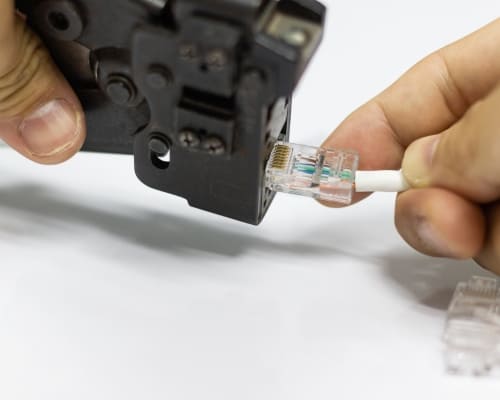
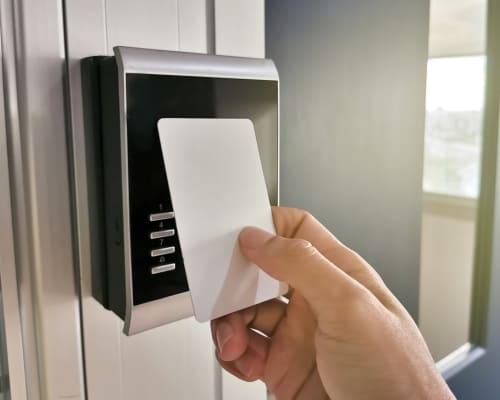
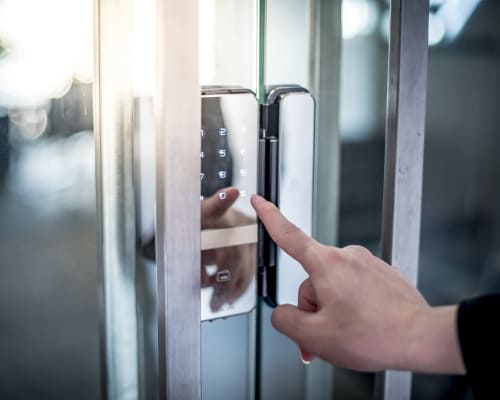
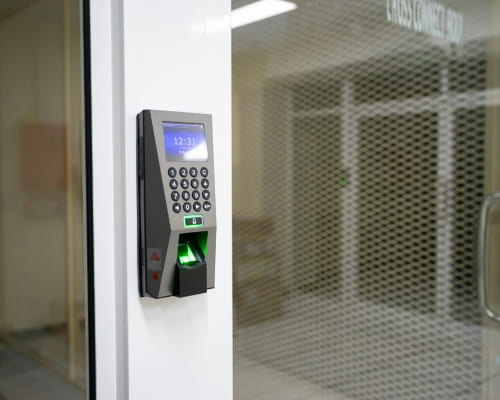
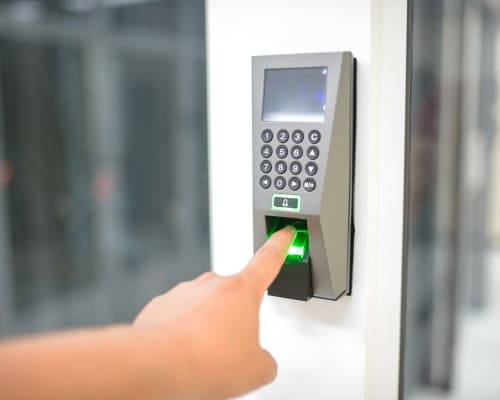
Most businesses reach access control the same way: a staff member leaves without returning a key, and the owner realises they have no idea how many copies are circulating or what rekeying every door would cost. The problem is not the lock, it is that a mechanical key cannot be cancelled. The simplest system is a standalone keypad on one door, where a shared code releases the lock. It costs the least, it needs no cabling back to a controller, and it has one real weakness: a shared code is only as private as the least careful person who knows it, and it never gets changed after somebody leaves. Card and fob systems are the next step up, giving each person their own credential that can be cancelled individually the day they hand in their notice, which is the entire point for any business with staff turnover. Mobile credentials do the same job using a phone, which suits sites where people forget cards and where you want to issue access remotely to a contractor. Intercom-integrated access is common on shared residential entries, where a video door station both identifies the caller and releases the door. On the locking side there are two families: electric strikes, which replace the keeper in a timber or metal door frame and suit most standard doors, and magnetic locks, typically specified around 300 kg holding force for a single leaf, which suit glass and aluminium entries where there is nothing to cut into. Larger sites add readers on both sides of a door for true in and out logging, plus a request-to-exit device or break-glass unit inside.
Visionova Security
Credentials, Egress And The Details That Decide Whether It Works

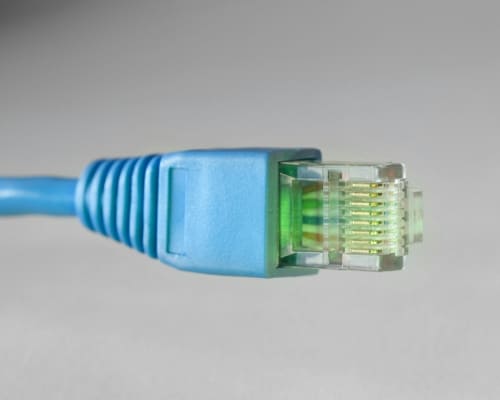
Two technical decisions matter far more than the brand on the reader. The first is the credential technology. A great many systems still sold as new use 125 kHz proximity cards, which have no encryption and can be copied by a handheld cloner costing less than fifty dollars, meaning anyone who borrows a card for thirty seconds can duplicate it undetectably. Encrypted credentials such as MIFARE DESFire EV2 and EV3 use mutual authentication and are the sensible specification for any site where access actually matters, and the price difference at installation is small. The second is egress. A door on an escape route must be fail-safe, meaning it releases when power is lost or the fire alarm activates, so people can always get out; a door protecting stock in a store room can be fail-secure and stay locked. Getting that backwards is not a preference, it is a life-safety failure, and it is the single most common fault we find on systems installed by non-specialists. Beyond that, the practicalities: readers wired back to a controller on Cat6 within the 90 metre permanent link limit, power supplies with battery backup so a brief outage does not lock a business out of its own premises, 20 mm conduit with galvanised saddles on any exposed external run, and door position switches so the system knows the difference between a door that was opened legitimately and one propped open all afternoon. Readers, controllers and door stations all run back on the same structured cabling we use for data points installation, which is why the two jobs belong on the same visit.
Visionova Security
Why Businesses Across Melbourne's West Choose Visionova Security
The commercial security market out here has grown faster than the supply of people licensed to serve it. The Western BACE business centre on Ferris Road in Cobblebank, the industrial estates spreading south of the Western Freeway and the retail strips on Station Road and Exford Road have all filled out since development began through the 2010s, most of it slab-on-ground tilt-panel and brick veneer built to a tight budget with locking hardware chosen by the builder rather than by anyone thinking about security, and a great deal of the access control that went in came from locksmiths adding electronics or from national suppliers shipping a kit for someone else to fit. Visionova Security holds Victorian Private Security Individual Licence Z70-718-31S endorsed as a Security Adviser and a Security Equipment Installer, which covers both the risk assessment and the physical work, and that number is publicly verifiable on the Victoria Police register. What that means for a business owner is a system specified around how the site actually operates, including who needs after-hours access, which doors are escape routes and what happens when a key person leaves. We do not sell software subscriptions you cannot exit, and we hand over the administration so you can add and cancel credentials yourself rather than paying for a call-out every time somebody starts. For shared residential entries we usually pair access control with a video intercom, so a caller can be identified before the door releases.
Visionova Security
What Access Control Costs Per Door
Access control is priced per door, and published 2026 pricing gives a clear picture of the two bands. A standalone or networked keypad system runs between $500 and $1,500 per door installed, covering the reader, the lock, the power supply and the labour. A card or fob system with a proper controller, encrypted credentials, request-to-exit device and door position switch runs between $1,000 and $3,000 per door, with more sophisticated multi-door installations sitting at the upper end. The variables that move your number are the door itself, since a glass entry needing a magnetic lock and a mounting bracket costs more than a timber door taking a strike; the cable distance back to the controller; whether the door forms part of an escape route and therefore needs fire-alarm interfacing; and whether you want readers on both sides for in and out logging. Credentials themselves are a few dollars each and are worth specifying as encrypted from day one rather than replacing the whole card population later. Multi-door sites get cheaper per door as the controller cost spreads. These are published market ranges instead of a Visionova Security price list, and we quote each door individually after walking the site. Call 0485 702 206.
Visionova Security
Keypad, Card Or Mobile: Choosing The Right Credential
A keypad is right when the group is small, stable and trusted, such as a family business or a store room used by two people. It is the cheapest to install and the cheapest to run because there are no credentials to buy or replace. Its failure mode is staff turnover: the code spreads, nobody changes it, and within two years you have no idea who can get in. Cards and fobs are right for any site with more than a handful of people or any real turnover, because each credential is individual, can be cancelled in seconds, and produces an audit trail showing who opened which door and when, which is genuinely useful when stock goes missing. The trade-off is that people lose them, so budget for replacements. Mobile credentials suit sites with contractors and casual access, since you can issue and revoke entitlements without anyone collecting a card, though they depend on people keeping a charged phone. Most businesses we work with end up on cards for staff and mobile for contractors, with a keypad kept only on internal doors where convenience beats accountability. Whatever the credential, our advice is the same: specify encryption from the start, because retrofitting it means replacing every card and every reader on site. Whichever credential you choose, pairing a reader with CCTV installation at the same door is what turns an access log into evidence. We walk the site, price each door individually in writing, and there is no charge for that visit. Call 0485 702 206 to arrange it.
Related Concreting Services
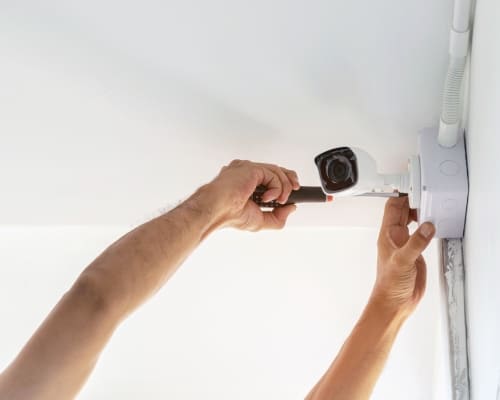
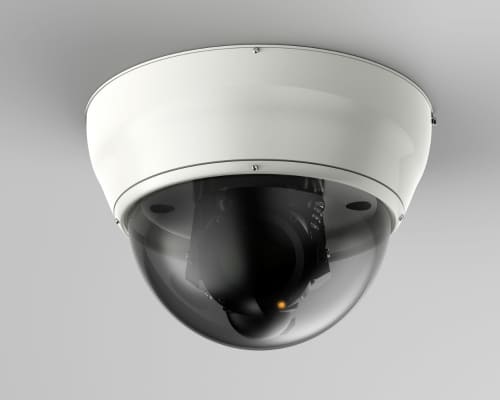
Professionally designed and installed security camera systems for homes and businesses across Melbourne's west, hardwired and recorded locally. Fixed written quote before we start, and the app set up on your phone before we leave.
Video door entry for houses, units and gates, installed so the camera actually sees a face and the door releases from your phone. Two-wire retrofits over existing intercom cable, or full IP systems on Cat6.
Cat6 data points, whole-home structured cabling and access point backhaul, terminated, tested and labelled at both ends. The permanent fix for dead spots and buffering that no plug-in booster will ever deliver.
TESTIMONIALS
What Our Access Control Customers Say About Us
The Process
3 Step Process For Your Access Control Needs

On-Site Security Assessment
We walk the property with you, check entry points, sight lines and cable routes, then recommend only the equipment your home or business actually needs.

Fixed-Price CCTV and Alarm Quote
You get a written price before anything starts, itemised by camera, sensor or point, with no hourly rate creeping up and no surprises on the invoice.

Licensed Installation and Handover
We install, test every device, set the app up on your phone and show you how it works before we leave your property.
Access Control In Rockbank
FREQUENTLY ASKED QUESTIONS
Everything you need to know about our Access Control In Rockbank
What is meant by access control?
Access control is any system that decides who can open which door, when, and keeps a record of it. In practice that means replacing a mechanical key with a credential such as a code, a card, a fob or a phone, connected to an electric lock. The reason businesses move to it is not convenience but revocability: when someone leaves, you cancel their credential in seconds instead of rekeying every lock and hoping no copies exist. It also produces an audit trail, which is what turns a suspicion into a fact.
What are the three types of access control?
For a physical door installation the three practical types are something you know, something you have and something you are: a code entered on a keypad, a card, fob or phone credential, and a biometric such as a fingerprint. Codes are cheapest and least accountable because they get shared. Cards and fobs are the standard for business use because each one is individual and can be cancelled. Biometrics remove the credential entirely but raise privacy obligations around storing personal data. Higher-security doors combine two, typically a card plus a PIN.
How much does access control cost per door?
Published 2026 pricing puts a keypad system between $500 and $1,500 per door installed, and a card or fob system with a proper controller, encrypted credentials and a request-to-exit device between $1,000 and $3,000 per door. The door type matters: a glass entry needing a magnetic lock costs more than a timber door taking an electric strike. Multi-door sites get cheaper per door because the controller cost spreads across them. We quote each door individually after walking the site. Call 0485 702 206.
What happens when a staff member leaves or loses their card?
You cancel that one credential and everything else keeps working, which is the entire reason to move away from keys. On a card or fob system it takes seconds and can be done by you rather than by us, because we hand over the administration as part of the installation rather than keeping it as a billable service. A lost card is cancelled and a new one issued for a few dollars. On a shared keypad code the answer is much worse: you have to change the code and tell everybody, which is exactly why keypads suit small stable groups and not businesses with turnover.
Is an electric lock on an exit door legal?
Yes, provided it is specified and wired correctly. Any door forming part of an escape route must be fail-safe, meaning it releases automatically when power is lost or the fire alarm activates, so nobody can be trapped inside. Doors that are not escape routes, such as a store room or a server room, can be fail-secure and remain locked during a power failure. Getting this the wrong way round is the most common serious fault we find on access control installed by non-specialists, and we check it on every system we are asked to service.
How long does it take to install access control on a commercial site?
A single door with a keypad or reader is usually a half to full day. A multi-door site with a central controller typically runs two to four days depending on cable distances, ceiling access and whether we are working around trading hours. Sites needing fire-alarm interfacing take longer because that interface has to be tested and witnessed. We stage commercial work so the business keeps operating, and we confirm the schedule with the written quote rather than on the day.
Request A Free Access Control Quote
GET A FREE QUOTE
BUSINESS
SERVICES
SERVICE AREAS
OPERATING HOURS
Sun: 7:00am - 9:00pm
Mon: 7:00am - 9:00pm
Tue: 7:00am - 9:00pm
Wed: 7:00am - 9:00pm
Thu: 7:00am - 9:00pm
Fri: 7:00am - 9:00pm
Sat: 7:00am - 9:00pm